
Mining sites punish clothing in ways most industries never will: sharp rock edges, constant abrasion, oil and grease exposure, repetitive kneeling and climbing, extreme temperature swings, and visibility requirements that cannot fade after a few washes. The result is predictable: standard uniforms tear early, crews get uncomfortable, replacement spend spikes, and your workwear program turns into continuous re-ordering.
This post breaks down job-ready, order-friendly specs for custom safety workwear in mining so you can build uniforms that last longer, fit better, and support compliance needs without overbuilding (and overpaying).
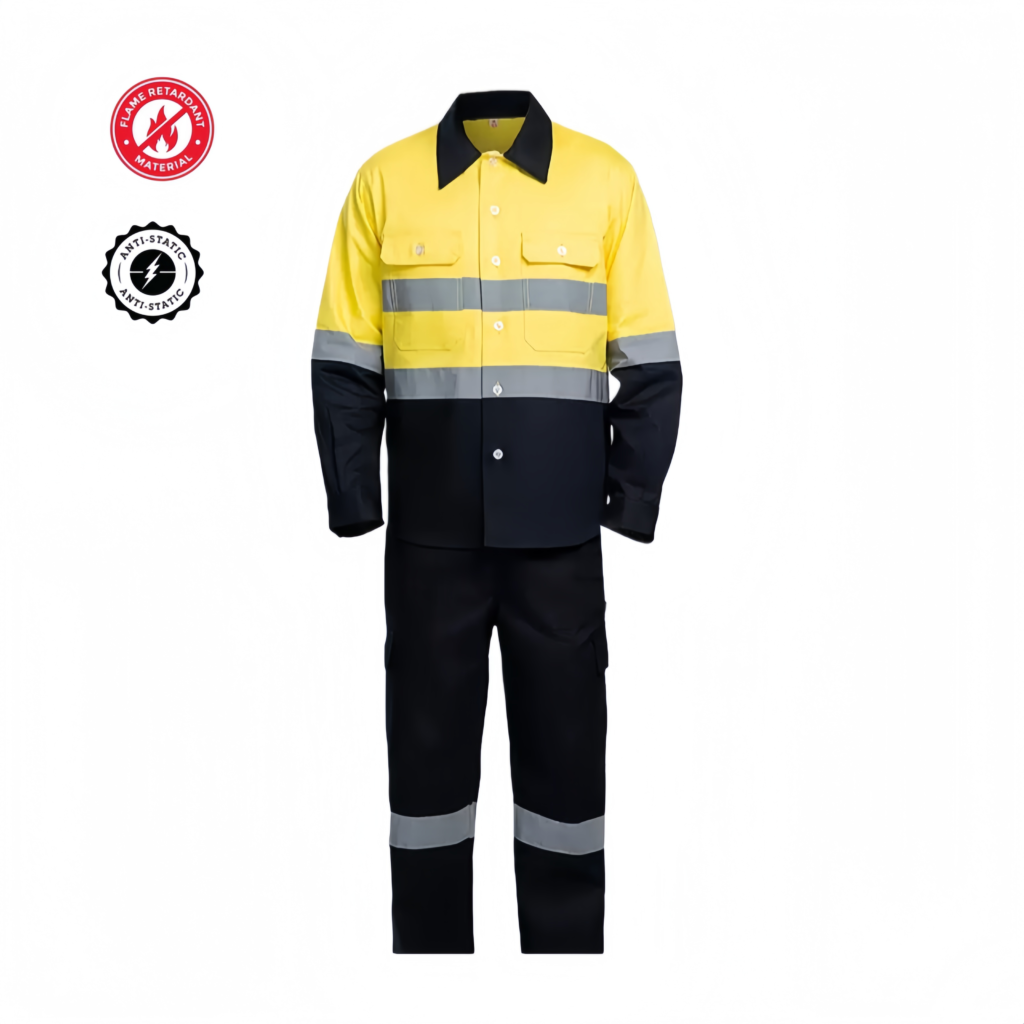
Custom Safety Workwear for Mining: Why Mining Uniforms Fail and What Specs Fix It
Most heavy-duty uniforms fail for reasons that have nothing to do with a logo or a single fabric choice. In mining, failures are usually tied to stress concentration, abrasion patterns, and construction details.
Custom Safety Workwear for Mining: The Four Failure Patterns
- Fabric weight or weave is too light for continuous abrasion (thighs, knees, cuffs).
- Weak seam construction at stress points (crotch, pockets, armholes, belt loops).
- Reinforcement exists, but not where the garment actually fails on your site.
- The performance mix is wrong (too hot, not breathable, poor mobility), so workers do not wear it correctly.
The fix is rarely just “thicker fabric.” The best results come from specifying the right base fabric plus targeted reinforcement, a stronger stitch package, and ergonomic patterning that matches how miners move.
Custom Safety Workwear for Mining: Heavy-Duty Uniform Specs Checklist
Use the checklist below as a baseline spec sheet when you compare manufacturers or request quotes for jackets, pants, coveralls, or hi-vis sets.
Custom Safety Workwear Fabric for Mining: Abrasion First, Comfort Always
A mining-ready fabric choice should balance:
- High abrasion resistance (strong outer face).
- Tear resistance (snag-and-stop behavior).
- Oil and soil tolerance (less permanent staining and slower degradation).
- Breathability and heat management (especially underground or hot climates).
Common fabric directions (select by site conditions):
- Heavy poly-cotton canvas or twill for general mining abrasion.
- Mechanical stretch or stretch panels to improve mobility and reduce seam stress.
- FR and/or anti-static blends when required by your hazard assessment or site rules.
Custom Safety Workwear Fabric Spec Tip for Mining: Reinforce Instead of Overweighting Everything
Instead of making the entire garment extremely heavy, use a durable base fabric and invest in targeted reinforcements and a stronger stitch package. This usually lasts longer and feels less bulky in daily wear.
Custom Safety Workwear Reinforcement for Mining: Put Armor Where Garments Actually Fail
Most mining wear-outs happen in predictable zones. A heavy-duty spec should reinforce:
- Knees (front and lower knee), with optional knee-pad insert pockets.
- Seat and rear rise for abrasion on surfaces and equipment.
- Inner thigh and crotch gusset to prevent tearing during climbing and wide steps.
- Cuffs and hems (boot friction and debris impact).
- Pocket openings and tool areas where repeated entry and exit cause fraying.
Custom Safety Workwear Reinforcement Materials for Mining: Three Practical Options
- Double-layer the same fabric (simple and cost-effective).
- Overlay higher-denier abrasion panels (longer service life).
- Use replaceable knee patches (extend garment life by swapping the wear zone).
Custom Safety Workwear Stitch Package for Mining: The Invisible Driver of Service Life
Great fabric fails fast with weak seams. For mining, specify:
- Higher stitch density in stress areas.
- Bar-tacks at pocket corners, belt loops, fly base, and key stress points.
- Double-needle or triple-needle seams where tension is highest.
- Clean seam finishing to resist fray from grit, dust, and industrial wash cycles.
Custom Safety Workwear Stitch Spec Tip for Mining: Use a Stress Map
Bring data from your current uniforms. Mark the top failure points (for example: knees, crotch, cuffs, pocket edges) and have the manufacturer match seam construction and bar-tack placement to those zones.
Custom Safety Workwear Trims and Closures for Mining: Don’t Let Zippers Be the Weakest Link
Mining environments destroy cheap trims. Consider:
- Heavy-duty zippers with strong pullers and reinforced zipper bases.
- Covered zippers in high-dust or spark-exposed areas.
- Snap or hook-and-loop solutions that still work with gloves and dust.
- Reinforced zipper starts and pocket edges to prevent tearing.
Custom Safety Workwear Mobility and Fit for Mining: Comfort Is a Safety Feature
Poor fit drives unsafe behavior (open jackets, rolled sleeves, awkward layering). Mining-ready pattern features include:
- Action back or pleated back for reach.
- Crotch gusset for climbing and wide steps.
- Articulated knees to reduce pulling and seam blowouts.
- Adjustable waist, hem, and cuffs for seasonal layering.
Custom Safety Workwear Bulk Sizing for Mining: Fit Samples Reduce Returns and Rework
For bulk orders, confirm a size set and validate key measurements (waist, inseam, chest, sleeve). A short fit-sample step typically saves significant remake and return costs.
Custom Safety Workwear Hi-Vis and Reflective for Mining: Visibility That Survives Wash and Dust
If hi-vis is required, prioritize:
- Reflective placement that remains visible with harnesses, vests, and backpacks.
- Tape that holds alignment and adhesion after repeated industrial wash cycles.
- Color choices that remain effective under site-specific dust and grime.
Custom Safety Workwear Weather System for Mining: One Uniform Rarely Fits All Seasons
If you operate across seasons, build a system rather than one “everything” garment:
- Lightweight breathable set for warm conditions.
- Insulated or lined jacket for cold conditions.
- Waterproof shell layer for wet and windy regions.
This approach controls cost: you avoid paying for insulation in summer gear, and you keep workers comfortable year-round.
Custom Safety Workwear for Mining: The “Heavy-Duty” Strategy That Doesn’t Overbuild
The strongest mining uniforms usually follow one formula:
- Durable base fabric + targeted reinforcement + premium seam package + ergonomic patterning.
This combination extends wear life, improves comfort, and reduces failures at stress points—meaning fewer emergency reorders and less downtime.
Custom Safety Workwear for Mining: Customization That Supports the Job, Not Just the Brand
Branding matters, but mining workwear should prioritize function-first customization:
- Logo placement that does not interfere with reflective tape or PPE contact areas.
- Role or ID labeling (safety, maintenance, supervisors) to streamline site management.
- Pocket layouts based on tool carry (radio pocket, pen slots, tape-measure loop).
- Optional QR or RFID labels for uniform issuance and tracking programs.
Custom Safety Workwear for Mining: Bulk Ordering Guide Without Surprises
A low-friction procurement flow most mining teams use:
- Define the use case (surface vs. underground, seasons, hazards, PPE pairing).
- Confirm performance needs (abrasion, FR, anti-static, waterproof, hi-vis).
- Choose the garment system (coverall vs. jacket + pants; optional shell layer).
- Approve the spec sheet and the size set.
- Order samples (fit and performance confirmation).
- Run mass production with quality checkpoints (stress points, tape alignment, sizing consistency).
- Plan rollout and reorders (staggered delivery, replacement policy, re-order cadence).
Procurement moves faster when you position this as a replacement-cost reduction project, not just a new-uniform request.
Custom Safety Workwear for Mining: Manufacturer Questions (Copy/Paste Checklist)
- What fabric options do you recommend for mining abrasion and comfort, and why?
- Where will you reinforce, and what material and weight will you use?
- What seam construction will you use at the crotch, knees, pockets, and belt loops?
- How do you ensure reflective tape placement and wash durability (if applicable)?
- What is your process for sizing approval (size set, fit samples, grading consistency)?
- What quality control checkpoints do you run before shipment?
- What are MOQ, lead time, and reorder options for continuity?
Custom Safety Workwear for Mining: FAQ
Custom Safety Workwear FAQ for Mining: How Do You Balance Durability and Heat Comfort?
Avoid making every panel heavy. Use a durable base fabric, reinforce only true failure zones, and add mobility or ventilation features where needed. This improves comfort without sacrificing lifespan.
Custom Safety Workwear FAQ for Mining: Are Coveralls Better Than Jacket and Pants?
Coveralls reduce waist exposure and are easy to standardize. Jacket and pants systems offer flexibility across temperatures and can reduce replacement cost because you can swap only the pants when knees fail.
Custom Safety Workwear FAQ for Mining: What Is the Most Common Reason Bulk Orders Go Wrong?
Sizing and spec ambiguity. A clear spec sheet plus a short fit-sample step prevents most issues and reduces rework.
Custom Safety Workwear FAQ for Mining: Can I Add a Logo Without Affecting Safety Features?
Yes. Place branding away from reflective tape paths and high-wear zones, and choose decoration methods that hold up to industrial washing.
Custom Safety Workwear for Mining: Conclusion
In summary, investing in high-quality custom safety workwear for mining is essential for enhancing both worker safety and operational efficiency. By focusing on durable materials and thoughtful design, companies can ensure that their uniforms withstand the rigors of the mining environment while providing maximum protection. This strategic approach not only minimizes the need for frequent replacements but also maintains a professional appearance across all teams. Ultimately, prioritizing robust safety workwear is a critical component in fostering a safe and reliable mining operation.


 Thai
Thai  English
  Russian
  Arabic
  Portuguese
  Japanese
  German
  Spanish
  Afrikaans
  Greek
Greek  Italian
  French