
Safety workwear is widely used in manufacturing, construction, logistics, automotive repair, electronics, utilities, mining, welding, petrochemical production and many other industries.
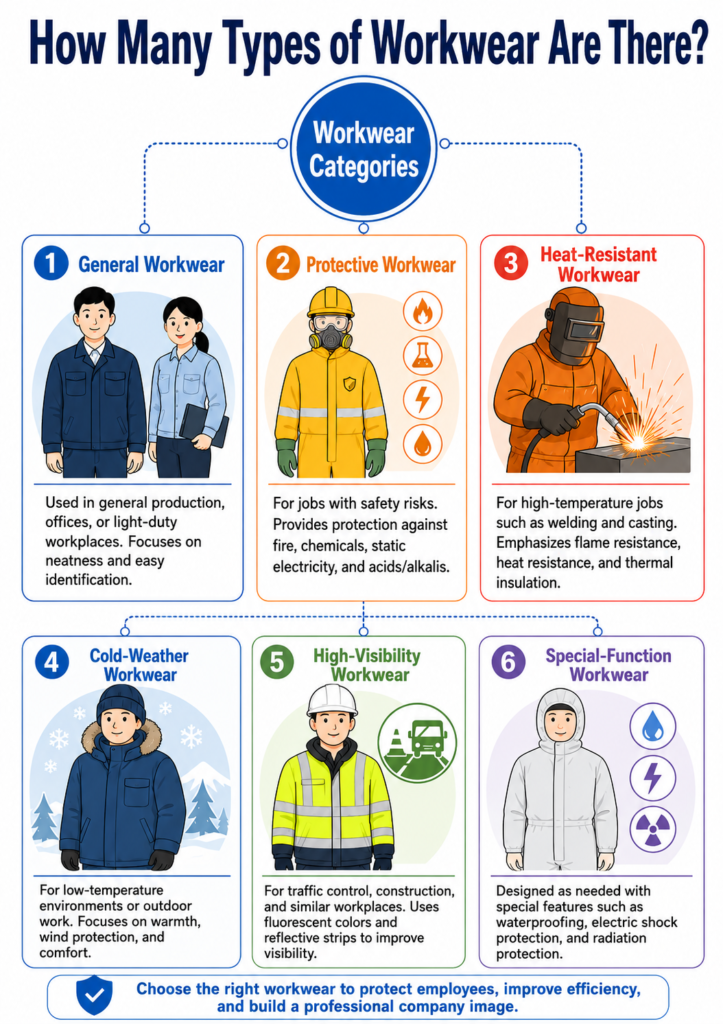
Unlike ordinary clothing, safety workwear is designed for specific working conditions. It may help protect workers from dirt, abrasion, minor mechanical contact, static electricity, heat, flame, chemical splashes and other workplace hazards.
Different jobs require different levels of protection. A warehouse employee may mainly need durable and breathable work clothing. An electronics worker may require antistatic garments. A welder may need flame-resistant clothing, while a chemical plant worker may require acid-resistant or chemical-protective workwear.
For this reason, companies should not select safety workwear based only on price, appearance or fabric thickness. Fabric composition, fabric weight, protective performance, working conditions, climate, garment design and maintenance requirements should all be considered.
This guide explains what safety workwear is, which fabrics are commonly used, how different fabric weights affect performance, what types of protective work clothing are available, and how to select, customize and maintain suitable workwear.
What is safety workwear?
Safety workwear refers to clothing worn by employees during manufacturing, construction, maintenance, transportation and other occupational activities.
Its basic purpose is to support daily work while providing an appropriate level of protection for the working environment.
General industrial workwear is usually designed to be:
- Durable and abrasion-resistant
- Easy to wash and maintain
- Comfortable for long working hours
- Suitable for bending, lifting and repeated movement
- Practical for carrying small tools
- Easy to identify by department or company
Some workplaces involve additional hazards, including static electricity, flame, radiant heat, molten metal, electric arc or chemical liquids. Employees in these environments need specialized protective clothing rather than ordinary work uniforms.
Examples include:
- Antistatic workwear
- Flame-resistant workwear
- Acid- and alkali-resistant clothing
- Arc-rated clothing
- Welding protective clothing
- Chemical protective suits
Ordinary workwear and certified protective clothing are not the same. Where specific occupational hazards exist, safety workwear should be selected according to a formal workplace risk assessment and the applicable safety requirements.
Common fabrics used for safety workwear
Common safety workwear fabrics include polyester-cotton blends, 100% cotton, twill, canvas, denim, antistatic fabrics, flame-resistant fabrics and acid- or alkali-resistant materials.
These names do not always describe the same type of textile characteristic.
Polyester-cotton and pure cotton describe the fiber composition. Twill, canvas and denim mainly describe the fabric structure or construction. Therefore, twill and canvas can be made from cotton, polyester-cotton blends or other fibers.
Polyester-cotton fabrics
Polyester-cotton fabric is made by blending polyester and cotton fibers.
Polyester improves abrasion resistance, wrinkle resistance, drying speed and dimensional stability. Cotton improves moisture absorption, breathability and comfort.
Because it balances durability and comfort, polyester-cotton fabric is one of the most widely used materials for safety workwear.
Common polyester-cotton ratios
Fabric composition is normally expressed as the polyester percentage followed by the cotton percentage. For example, 65/35 means 65% polyester and 35% cotton.
| Ratio | Состав | Main characteristics | Common applications |
| 90/10 | 90% polyester, 10% cotton | Durable, firm and economical, but less absorbent | Property services, warehousing and cleaning uniforms |
| 80/20 | 80% polyester, 20% cotton | Wrinkle-resistant, quick-drying and easy to maintain | Factory and logistics workwear |
| 65/35 | 65% polyester, 35% cotton | Good balance of durability and comfort | Manufacturing, construction and automotive workwear |
| 60/40 | 60% polyester, 40% cotton | Softer cotton feel and improved comfort | Indoor production and maintenance work |
| 50/50 | 50% polyester, 50% cotton | Balanced moisture management and durability | Mid-range and premium industrial uniforms |
| 40/60 | 40% polyester, 60% cotton | Softer, more breathable and more absorbent | Warm environments and summer workwear |
| 35/65 | 35% polyester, 65% cotton | Close to a cotton feel but more prone to wrinkling | Comfort-focused work clothing |
Polyester-rich blends are commonly marked as T/C, such as T/C 65/35. Cotton-rich polyester blends may be marked as CVC, such as CVC 60/40.
For general safety workwear, T/C 65/35 is one of the most common options because it provides a practical balance of strength, washability, appearance and comfort.
Common polyester-cotton fabric weights
Fabric weight is normally measured in grams per square meter, written as g/m² or GSM.
| Fabric weight | Typical characteristics | Common applications |
| 120-150 GSM | Lightweight and breathable, with limited abrasion resistance | Summer shirts and short-sleeve uniforms |
| 150-170 GSM | Light and flexible | Summer safety workwear |
| 170-190 GSM | Moderate weight | Long-sleeve summer garments and light spring workwear |
| 200-220 GSM | Firm and durable | General spring and autumn work uniforms |
| 220-250 GSM | Heavier and more abrasion-resistant | Mechanical, construction and automotive workwear |
| 250-300 GSM | Thick and robust | Cold-season outer garments and heavy-duty workwear |
| Above 300 GSM | Very heavy, with reduced flexibility | Specialized heavy-duty clothing |
For general spring and autumn safety workwear, polyester-cotton twill between 200 and 240 GSM is commonly used.
Summer garments often use fabrics between 150 and 190 GSM. Heavier outer garments may use materials between 230 and 300 GSM.
Pure cotton fabrics
Pure cotton fabric usually refers to material labeled as 100% cotton or containing a very high percentage of cotton.
Cotton is breathable, moisture-absorbing and comfortable for extended wear. It also generates less static than many synthetic fabrics under ordinary conditions.
However, cotton can wrinkle and shrink. Its dimensional stability and abrasion resistance may also be lower than those of polyester-cotton blends.
Common pure cotton fabric weights
| Fabric weight | Typical characteristics | Common applications |
| 110-140 GSM | Very light and breathable | Summer shirts and short-sleeve garments |
| 140-170 GSM | Lightweight and absorbent | Summer work uniforms |
| 170-190 GSM | Moderate weight | Long-sleeve summer and light workwear |
| 190-220 GSM | Firm with balanced comfort and durability | General spring and autumn garments |
| 220-250 GSM | Thick and abrasion-resistant | Mechanical, automotive and construction workwear |
| 250-300 GSM | Heavy and robust | Cold-season clothing and heavy-duty work garments |
| 300-350 GSM | Firm and very durable | Cotton canvas workwear |
| Above 350 GSM | Very heavy | Protective aprons and specialized abrasion-resistant products |
Summer cotton workwear commonly uses fabric between 140 and 190 GSM.
For spring and autumn work clothing, fabrics between 200 and 250 GSM are common. Cotton twill between 200 and 240 GSM is frequently selected for general industrial workwear.
Twill fabrics
Twill is not a specific fiber. It is a woven fabric structure identified by visible diagonal lines on the surface.
Twill is commonly used for safety workwear because it is firm, durable and resistant to abrasion. The actual performance depends on the fiber composition, yarn count, weaving density and finishing process.
Common twill compositions
| Twill type | Common composition | Main characteristics |
| Cotton twill | 100% cotton | Breathable and comfortable, but may shrink |
| Polyester-cotton twill | 65% polyester, 35% cotton | Durable, firm and well-balanced |
| Polyester-cotton twill | 80% polyester, 20% cotton | Easy to wash, wrinkle-resistant and quick-drying |
| Cotton-rich twill | 60% cotton, 40% polyester or similar | Softer cotton feel with improved stability |
| Polyester twill | 100% polyester | Quick-drying and wrinkle-resistant, but less absorbent |
| Cotton stretch twill | 97% cotton, 3% elastane or similar | Comfortable and flexible |
| Polyester-cotton stretch twill | Polyester, cotton and elastane | Durable with improved freedom of movement |
| Nylon-cotton twill | Nylon and cotton | Strong and abrasion-resistant |
| Functional twill | Cotton, polyester-cotton or protective fibers | May include antistatic, flame-resistant or water-repellent properties |
Common twill fabric weights
Twill fabrics used for clothing commonly range from approximately 130 to 350 GSM. Safety workwear generally uses twill between 180 and 260 GSM.
| Fabric weight | Typical characteristics | Common applications |
| 130-150 GSM | Легкий и дышащий | Summer shirts |
| 150-180 GSM | Light and flexible | Summer work uniforms |
| 180-200 GSM | Moderate weight | Long-sleeve summer and light spring workwear |
| 200-220 GSM | Firm and abrasion-resistant | General industrial uniforms |
| 220-240 GSM | Heavier and durable | Manufacturing and mechanical workwear |
| 240-260 GSM | Thick and robust | Construction, automotive repair and outdoor work |
| 260-300 GSM | Heavy | Autumn and winter workwear |
| 300-350 GSM | Very firm and less flexible | Heavy-duty garments |
A common specification for general factory safety workwear is T/C 65/35 polyester-cotton twill weighing between 200 and 240 GSM.
Canvas fabrics
Canvas is a strong fabric woven with relatively coarse yarns and a dense construction. It is known for abrasion resistance, tear strength and durability.
Canvas is not limited to one fiber composition. It can be made from cotton, polyester-cotton, polyester, nylon or other blended fibers.
Common canvas compositions
| Canvas type | Common composition | Main characteristics |
| Cotton canvas | 100% cotton | Breathable and natural, but may shrink |
| Polyester-cotton canvas | 65% polyester, 35% cotton | Strong, firm and washable |
| Polyester-cotton canvas | 80% polyester, 20% cotton | Quick-drying and wrinkle-resistant |
| Cotton-rich canvas | Cotton-rich polyester blend | More comfortable with improved stability |
| Polyester canvas | 100% polyester | Strong, quick-drying and suitable for coating |
| Nylon canvas | 100% nylon | Lightweight and highly abrasion-resistant |
| Nylon-cotton canvas | Nylon and cotton | Combines strength with a cotton feel |
| Stretch canvas | Cotton or polyester-cotton with elastane | Heavy but more flexible |
| Functional canvas | Cotton, polyester-cotton or synthetic fibers | May be treated for water, oil, mildew or flame resistance |
Common canvas fabric weights
Canvas covers a wide range of weights. Canvas used for safety workwear generally falls between 220 and 450 GSM. Industrial covers and tarpaulins may exceed 600 GSM.
| Fabric weight | Typical characteristics | Common applications |
| 180-220 GSM | Light and relatively soft | Light-duty summer workwear and aprons |
| 220-260 GSM | Medium-light canvas | Spring workwear and lightweight trousers |
| 260-300 GSM | Moderate canvas weight | Work jackets and general safety workwear |
| 300-350 GSM | Thick and abrasion-resistant | Mechanical, automotive and construction garments |
| 350-450 GSM | Heavy and firm | Heavy-duty workwear and protective aprons |
| 450-600 GSM | Very heavy | Tool bags, tents and equipment covers |
| Above 600 GSM | Extra-heavy | Industrial tarpaulins and transport covers |
For general industrial clothing, cotton or polyester-cotton canvas between 260 and 320 GSM is a practical option.
For work trousers and jackets exposed to significant abrasion, fabrics between 300 and 380 GSM may be more suitable.
Denim fabrics
Denim is generally a twill fabric woven using dyed warp yarns and lighter or undyed weft yarns.
It is durable and has a distinctive appearance, making it suitable for work trousers, jackets and maintenance clothing.
Common denim compositions
| Denim type | Common composition | Main characteristics |
| Cotton denim | 100% cotton | Durable, absorbent and naturally comfortable |
| Polyester-cotton denim | Cotton and polyester | Wrinkle-resistant, washable and dimensionally stable |
| Stretch denim | 97% cotton and 3% elastane, or similar | Flexible and comfortable |
| Polyester-cotton stretch denim | Cotton, polyester and elastane | Durable, stable and flexible |
| Cotton-Lyocell denim | Cotton and Lyocell | Soft with good moisture management |
| Cotton-linen denim | Cotton and linen or hemp | Breathable with a natural texture |
| Recycled cotton denim | Cotton and recycled cotton, sometimes with polyester | Uses recycled fiber content |
Common denim weights
Denim weight is often expressed in ounces per square yard, abbreviated as oz. One oz/yd² is approximately 33.9 GSM.
| Denim weight | Approximate GSM | Common applications |
| 4-6 oz | 136-203 GSM | Summer shirts and lightweight garments |
| 6-8 oz | 203-271 GSM | Summer trousers and light workwear |
| 8-10 oz | 271-339 GSM | Everyday denim and light industrial garments |
| 10-12 oz | 339-407 GSM | Standard jeans and work trousers |
| 12-14 oz | 407-475 GSM | Industrial workwear and mechanical repair clothing |
| 14-16 oz | 475-542 GSM | Heavy-duty outdoor work trousers |
| Above 16 oz | Above 542 GSM | Extra-heavy abrasion-resistant products |
For ordinary safety workwear, denim between 10 and 13 oz, or approximately 340 to 440 GSM, is a common choice.
Workers who frequently bend, squat or climb may benefit from stretch denim containing approximately 1% to 3% elastane.
Antistatic fabrics
Antistatic fabric usually contains conductive fibers integrated into a polyester, polyester-cotton or cotton base fabric.
The conductive fibers may be arranged in stripes, grids or a blended structure. Their purpose is to reduce electrostatic charge accumulation and allow charge to dissipate more effectively.
Antistatic safety workwear is commonly used in electronics manufacturing, precision production, pharmaceutical facilities, cleanrooms and certain petrochemical environments.
Common antistatic fabric compositions
| Fabric type | Common composition | Typical weight |
| Polyester antistatic fabric | 98%-99.5% polyester and 0.5%-2% conductive fiber | 100-180 GSM |
| Polyester-cotton antistatic fabric | Polyester, cotton and approximately 1% conductive fiber | 150-250 GSM |
| Cotton-rich antistatic fabric | Cotton, polyester and conductive fiber | 200-310 GSM |
| Cotton antistatic fabric | Cotton with approximately 1% conductive fiber | 180-300 GSM |
| Flame-resistant antistatic fabric | Flame-resistant fibers and conductive fiber | 150-380 GSM |
Common antistatic fabric weights
- 100-150 GSM: cleanroom garments, dust-control suits and light coveralls
- 150-190 GSM: summer antistatic workwear
- 190-250 GSM: spring and autumn antistatic safety workwear
- 250-310 GSM: heavier antistatic work clothing
- Above 300 GSM: multifunctional or heavy-duty protective fabrics
Antistatic workwear is not electrical insulation clothing. It is intended to control static electricity and should not be used as protection against live electrical voltage.
Flame-resistant fabrics
Flame-resistant fabrics can be divided into two main categories: treated flame-resistant fabrics and inherently flame-resistant fabrics.
Treated fabrics are made from materials such as cotton and then given a chemical flame-resistant finish.
Inherently flame-resistant fabrics are made from fibers that naturally resist ignition or flame spread. Examples include aramid, modacrylic and flame-resistant viscose.
Common flame-resistant fabric compositions
| Fabric type | Common composition | Typical weight |
| Flame-resistant cotton | 100% cotton with flame-resistant treatment | 180-350 GSM |
| Flame-resistant cotton-polyester | Cotton and polyester with specialized treatment | 200-380 GSM |
| Modacrylic blend | Modacrylic, cotton, nylon and sometimes conductive fiber | 140-340 GSM |
| Aramid blend | Meta-aramid, para-aramid and other protective fibers | 150-300 GSM |
| Flame-resistant viscose blend | FR viscose with aramid or modacrylic | 160-300 GSM |
| Flame-resistant antistatic fabric | FR fibers and conductive fibers | 150-380 GSM |
| Multilayer FR fabric | FR outer fabric, functional membrane and FR lining | 300-600 GSM or more |
Common flame-resistant fabric weights
- 140-180 GSM: lightweight flame-resistant shirts and summer garments
- 180-240 GSM: long-sleeve summer and light spring workwear
- 240-300 GSM: general flame-resistant suits and coveralls
- 300-380 GSM: welding, metallurgy and heavy industrial applications
- Above 380 GSM: multilayer thermal or specialized high-heat protection
A heavier fabric may provide greater thermal insulation and mechanical strength, but weight alone does not determine flame-resistant performance.
Buyers should also review after-flame time, afterglow time, char length, thermal stability and performance after repeated washing.
Arc-rated clothing is also different from ordinary flame-resistant workwear. Where electric arc hazards exist, specifically tested and rated garments should be used.
Acid- and alkali-resistant fabrics
Acid- and alkali-resistant fabrics are intended to reduce worker exposure to certain acidic or alkaline liquids.
These materials can be divided into woven liquid-repellent fabrics and coated or laminated chemical barrier materials.
Woven fabrics may be more breathable and suitable for limited splashes. Coated or multilayer barrier fabrics generally provide stronger liquid resistance but may be less breathable.
Common acid- and alkali-resistant fabric compositions
| Fabric type | Common composition or construction | Typical weight |
| Polyester chemical-resistant fabric | 100% polyester with acid- and alkali-repellent treatment | 150-260 GSM |
| Polyester-cotton chemical-resistant fabric | Polyester-cotton with liquid-repellent treatment | 200-280 GSM |
| Multifunctional cotton-rich fabric | Cotton, polyester, conductive fiber and splash-resistant finish | 240-350 GSM |
| Nylon chemical-resistant fabric | Nylon base fabric with chemical-resistant finish or coating | 150-300 GSM |
| PVC-coated fabric | Polyester or nylon base with PVC coating | 300-700 GSM |
| PU-coated fabric | Polyester or nylon base with polyurethane coating | 150-450 GSM |
| PE-laminated material | Nonwoven fabric with polyethylene barrier film | Approximately 50-180 GSM |
| Multilayer barrier fabric | Base fabric with multilayer polymer barrier film | 100-500 GSM or more |
General woven acid- and alkali-resistant safety workwear commonly uses fabrics between 200 and 300 GSM.
The weight of coated or multilayer materials varies significantly and should be selected according to the chemical hazard rather than garment weight alone.
Before selecting chemical-resistant workwear, the employer should identify:
- The chemical name
- Concentration
- Liquid temperature
- Type of exposure
- Splash or spray pressure
- Expected contact time
- Whether special chemicals such as hydrofluoric acid, ammonia or organic solvents are involved
General acid-resistant clothing does not protect against every chemical. High concentrations, pressurized sprays, prolonged exposure and highly hazardous chemicals may require specialized chemical protective suits.
Types of safety workwear
Safety workwear can be classified by season, garment style and protective function.
Seasonal classifications
Summer workwear is usually made from light, breathable fabrics. Polyester-cotton or cotton twill between 150 and 190 GSM is commonly used.
Spring and autumn workwear often uses twill, cotton or polyester-cotton fabrics between 200 and 250 GSM.
Winter safety workwear normally includes an outer fabric, insulation and a lining. Warmth depends not only on the outer fabric weight but also on the insulation material, filling weight and garment structure.
Garment styles
- Two-piece work suits
- Work jackets
- Work trousers
- Coveralls
- Bib overalls
- Long-sleeve workwear
- Short-sleeve workwear
- Insulated work jackets
- Protective aprons
- Protective sleeves
Protective functions
- General abrasion-resistant workwear
- Antistatic workwear
- Flame-resistant workwear
- Acid- and alkali-resistant workwear
- Oil- and water-repellent clothing
- Cleanroom garments
- High-visibility workwear
- Arc-rated clothing
- Welding protective clothing
- Chemical protective clothing
Different functions are not automatically interchangeable. A flame-resistant garment may not be antistatic, and an antistatic garment is not necessarily arc-rated.
Applications of safety workwear
Manufacturing and machinery
Workers may come into contact with machinery, metal components, grease and abrasive surfaces. Suitable options include polyester-cotton twill, cotton twill, canvas and denim.
Construction and engineering
Construction safety workwear should be durable, practical and suitable for outdoor conditions. High-visibility colors or reflective tape may also be necessary where workers are exposed to traffic or moving equipment.
Warehousing and logistics
Warehouse and logistics employees frequently walk, lift and bend. Their workwear should be lightweight, durable, washable and flexible. Polyester-cotton twill is often a suitable choice.
Automotive repair
Automotive workwear should resist abrasion and frequent staining while providing practical pockets and freedom of movement. Polyester-cotton canvas and stretch denim are commonly used.
Electronics and precision manufacturing
Some electronics and precision-production environments require control of electrostatic discharge. Antistatic safety workwear may be required for these applications.
Petrochemical operations
Petrochemical workplaces may involve static electricity, flame, heat and chemical splash hazards. Depending on the job, workers may need flame-resistant, antistatic or chemical-protective clothing.
Welding and metallurgy
Welding and metalworking employees may be exposed to sparks, heat and molten metal splash. Appropriate flame-resistant or welding protective clothing should be selected according to the specific hazard.
Electrical utilities
General electrician uniforms, flame-resistant clothing and arc-rated garments serve different purposes. Where electric arc exposure is possible, arc-rated protective clothing should be selected.
Pharmaceutical and clean production
Pharmaceutical, food-processing and cleanroom environments often focus on contamination control, cleanliness and static management. Lightweight polyester antistatic fabrics are commonly used.
How to choose suitable safety workwear
The best approach is to select safety workwear according to workplace hazards first, then balance protection, durability and comfort.
Identify workplace hazards
The employer should determine whether employees are exposed to:
- Абразия
- Oil and dirt
- Static electricity
- Flame
- Radiant heat
- Электрическая дуга
- Acid or alkali liquids
- Chemical splashes
- Low outdoor temperatures
- Vehicle and machinery traffic
For low-risk environments, durability, washability and comfort may be the main priorities.
Where specialized hazards exist, protective performance should take priority over appearance or price.
Select fabric weight according to climate
Summer safety workwear should be light and breathable, but it should still provide sufficient durability for the job.
Spring and autumn garments commonly use polyester-cotton or cotton twill between 200 and 250 GSM.
Winter workwear should be evaluated as a complete system, including the outer fabric, wind resistance, insulation and lining.
Consider the level of physical activity
Workers who frequently bend, squat, climb or raise their arms need garments with sufficient ease of movement.
Stretch fabric, ergonomic cutting, reinforced knees and articulated panels may improve comfort and mobility.
Consider washing frequency
Workwear that is washed frequently may benefit from polyester-rich fabrics with better wrinkle resistance and dimensional stability.
If industrial laundering is used, confirm that the fabric, reflective tape, fasteners and protective finishes can withstand the required washing temperature, detergent and drying method.
Review testing and certification
Functional protective clothing should not be selected based only on the product name.
Buyers should review the test items, applicable standard, protection level, washing durability and intended use of the garment.
How to customize safety workwear
A typical customization process includes identifying requirements, selecting fabrics, designing the garment, collecting sizes, approving samples and starting bulk production.
Identify employee groups and hazards
The company should first classify employees according to job function, workplace conditions, physical activity and protective requirements.
Different employee groups may need different safety workwear rather than one uniform design for every position.
Select the fabric and weight
- Summer general workwear: 150-190 GSM polyester-cotton or cotton twill
- Spring and autumn workwear: 200-250 GSM polyester-cotton or cotton twill
- High-abrasion workwear: 260-350 GSM canvas
- Denim workwear: approximately 340-475 GSM
- Specialized workwear: tested antistatic, flame-resistant or chemical-resistant fabric
Design the garment structure
Useful design features may include:
- Multiple utility pockets
- Zipper or button closures
- Adjustable cuffs
- Elastic or adjustable waistbands
- Reinforced elbows and knees
- Светоотражающая лента
- Removable insulated lining
- Tool loops
- Ventilation panels
Every design feature should support the actual job rather than being added only for appearance.
Add company branding
Company names, logos, department names and employee identification may be applied through embroidery, printing, woven labels or removable patches.
Branding methods should not compromise the garment’s protective performance. Logos, threads, reflective materials and fasteners used on specialized protective clothing should be compatible with the garment’s intended function.
Collect employee sizes
Employee sizing should consider height, weight, chest, waist and actual fitting results.
Custom measurements may be needed for employees whose body dimensions do not fit the standard size range.
Approve a sample garment
For large orders, companies should approve a sample before mass production.
The sample should be checked for:
- Fabric composition
- Fabric weight
- Цвет
- Fit
- Размер
- Pocket position
- Logo appearance
- Zipper and button quality
- Reflective materials
- Shrinkage and color change after washing
Sample approval helps reduce production errors and ensures that the final safety workwear meets both practical and visual requirements.
How to care for safety workwear
Proper maintenance can extend garment life and help preserve its intended performance.
Follow the care label
Different fabrics have different requirements for washing temperature, detergents, drying and ironing.
Cotton fabrics may shrink. Polyester and polyester-cotton fabrics should be protected from excessive heat that may damage fibers, coatings or accessories.
Separate contaminated workwear
Workwear contaminated with grease, industrial dust or chemicals should not normally be washed with household clothing.
Garments exposed to hazardous substances should be handled according to the employer’s contamination-control and professional laundering procedures.
Treat stains promptly
Oil and chemical stains should be treated according to approved procedures.
Do not use strong oxidizing agents, bleach or solvents on functional safety workwear unless the product instructions specifically permit them.
Dry and store garments properly
After washing, garments should be fully dried and stored in a clean, dry and ventilated area.
Long-term damp storage may lead to odor, mold growth and deterioration of the fabric or protective finish.
Inspect garments regularly
Frequently inspect:
- Манжеты
- Elbows
- Knees
- Trouser hems
- Seat and crotch seams
- Pockets
- Zippers
- Buttons
- Светоотражающая лента
- Conductive fabric connections
Garments with severe abrasion, holes, broken seams or damaged protective layers should be repaired or replaced.
Manage functional garments separately
Antistatic, flame-resistant and chemical-resistant clothing should be washed and maintained according to the manufacturer’s instructions.
Fabric softeners, bleach, strong alkaline detergents and unsuitable industrial laundry processes may reduce antistatic, flame-resistant or liquid-repellent performance.
Companies should maintain records for the issue, laundering, inspection, replacement and disposal of specialized safety workwear.
Safety workwear fabric selection reference
| Working environment | Suggested fabric | Suggested weight |
| General summer workshop | Polyester-cotton or cotton twill | 150-190 GSM |
| General factory in spring and autumn | T/C 65/35 twill | 200-240 GSM |
| Hot indoor workshop | Cotton twill | 170-220 GSM |
| Mechanical maintenance | Polyester-cotton twill or canvas | 220-320 GSM |
| Строительство | Polyester-cotton twill or canvas | 240-350 GSM |
| Automotive repair | Polyester-cotton canvas or stretch denim | 260-440 GSM |
| Warehousing and logistics | Polyester-cotton twill | 170-220 GSM |
| Electronics manufacturing | Antistatic polyester or polyester-cotton | 110-240 GSM |
| Welding and metallurgy | Flame-resistant cotton or inherent FR blend | 240-380 GSM |
| Limited acid or alkali splash | Woven chemical-resistant fabric | 200-300 GSM |
| High-risk chemical work | Coated or multilayer chemical barrier material | Select according to the chemical hazard |
These fabric weights represent common market ranges. They should only be used as an initial reference.
Actual performance also depends on fiber composition, yarn construction, weave density, finishing process, garment design and laboratory test results.
Заключение
There is no single fabric that is suitable for every type of safety workwear.
Polyester-cotton fabric is durable, wrinkle-resistant and easy to maintain. Pure cotton is breathable, absorbent and comfortable. Twill is suitable for general industrial uniforms. Canvas works well in high-abrasion environments, while denim combines durability with a recognizable workwear appearance.
Antistatic, flame-resistant and acid- or alkali-resistant fabrics are specialized protective materials. Their suitability cannot be judged only by fiber composition or fabric weight.
Before purchasing or customizing safety workwear, companies should identify workplace hazards, define the required protection, and then select the appropriate fabric, weight, garment design and maintenance procedure.
Correctly selected safety workwear can support worker comfort, improve durability, strengthen company identification and contribute to a safer working environment.


 Russian
  English
  Arabic
  Portuguese
  Japanese
  German
  Spanish
  Afrikaans
  Greek
Greek  Italian
  Thai
Thai  French