
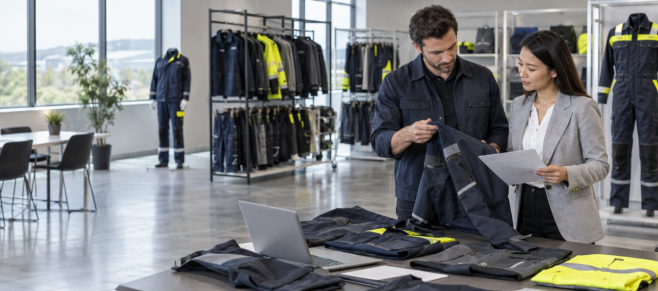
Choisir le bon custom workwear manufacturer affects more than the appearance of a garment. The supplier you select will influence fabric performance, sizing consistency, workmanship, delivery reliability and the way your brand is presented to customers or employees.
For importers, distributors and workwear brands, comparing factories only by unit price can create expensive problems later. A low quotation may hide unsuitable fabric, incomplete specifications, weak quality control or an unrealistic production schedule. This guide explains how to choose a custom workwear manufacturer by evaluating the ten factors that matter most before a bulk order is placed.
1. Define Your Requirements Before Choosing a Custom Workwear Manufacturer
A manufacturer cannot prepare an accurate quotation or sample without a clear product brief. Before contacting suppliers, define the garment type, intended working environment, expected order quantity and the level of customization required.
A useful workwear specification should cover:
- Garment type, such as work jackets, trousers, coveralls or coordinated workwear sets
- Target industry and working conditions
- Preferred fabric composition, weight and color
- Size range and measurement chart
- Pocket type, placement and functional details
- Reinforcement areas and required accessories
- Logo, label and packaging requirements
- Estimated order quantity and required delivery date
If the specification is incomplete, an experienced custom workwear manufacturer should be able to develop it from a sketch, reference garment or preliminary design. Any protective performance requirement should be stated separately. Product compliance must be confirmed with the relevant test reports or certificates for the exact fabric and garment being ordered.
2. Check the Manufacturer’s Industrial Workwear Experience
Not every clothing factory is suitable for industrial workwear. Fashion garments and workwear may use similar machinery, but the products have different requirements for durability, fit, reinforcement and functional construction.
Workwear Products the Manufacturer Has Produced
Ask the factory to show products that are similar to your project. Relevant examples may include work jackets, cargo trousers, bib pants, coveralls or two-piece workwear sets. A factory with related production experience is more likely to understand the correct construction sequence and common performance risks.
Construction Details the Factory Should Understand
A capable industrial custom workwear manufacturer should understand reinforced knees and elbows, bar-tacking at stress points, durable zippers, adjustable cuffs, tool pockets, cargo pockets and consistent reflective tape placement. Ask how these details are checked during sampling and production instead of relying only on showroom samples.
3. Evaluate Workwear Fabrics and Materials
Fabric selection affects comfort, durability, garment weight, washing performance and price. Compare suppliers using a complete fabric specification rather than composition alone.
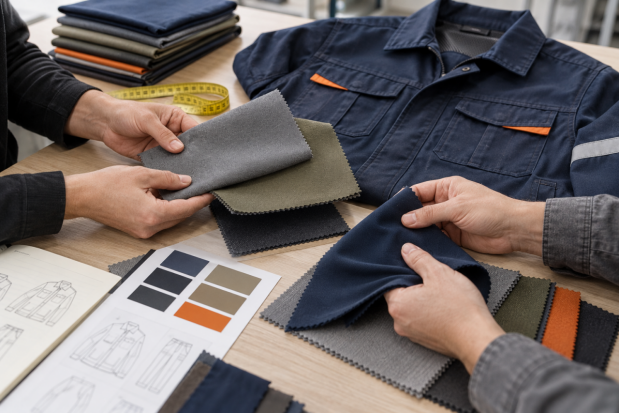
Cotton Workwear Fabric
Cotton is breathable and comfortable, which makes it suitable for general workwear and warm conditions. Buyers should still confirm fabric weight, weave, shrinkage and colorfastness because these factors vary between suppliers.
Polyester Cotton Workwear Fabric
Polyester-cotton fabric combines the comfort of cotton with the strength, drying speed and shape retention of polyester. It is widely used for work jackets, trousers, coveralls and industrial uniforms. The final performance depends on the blend ratio, yarn quality, weave and finishing process.
Stretch Fabric for Industrial Workwear
Stretch fabrics can improve mobility when workers bend, climb or kneel. They are often selected for modern work trousers and fitted jackets. Confirm whether stretch panels are placed only in movement areas or used across the complete garment, as this can affect both cost and durability.
For every proposed fabric, request the composition, weight in GSM, weave, available colors, shrinkage performance, colorfastness information and minimum fabric order quantity.
4. Review the OEM Workwear Manufacturer’s Customization Capabilities
Custom workwear should support both the job function and the buyer’s brand requirements. A qualified supplier should be able to explain which features can be changed and which changes require new patterns, custom materials or a higher MOQ.
Garment Design and Functional Customization
Functional customization may include pocket configuration, reinforced panels, reflective details, adjustable cuffs, elastic waistbands, detachable components and selected zippers or fasteners. Ask whether the factory prepares a technical drawing or specification sheet before sampling.
Custom Workwear with Logo and Private Labels
Brand customization may include embroidery, screen printing, heat transfer, woven labels, printed labels, hangtags, individual bags and custom cartons. The best logo method depends on the fabric, design detail, order quantity and expected washing conditions. Approve the logo on the actual garment fabric before bulk production.
5. Compare Custom Workwear MOQ Requirements
Minimum order quantity is especially important for distributors, new brands and buyers testing a new style. Ask whether the quoted MOQ applies to the whole order, each style, each color or each fabric.
What Affects the Minimum Order Quantity
MOQ may be influenced by fabric availability, custom-dyed colors, size distribution, custom accessories, logo application, private labels and packaging. Even when the garment factory accepts a small order, the fabric mill or accessory supplier may require a larger minimum quantity.
How to Reduce the MOQ for a Trial Order
Using an available fabric, standard color or existing accessory can sometimes reduce the MOQ. Buyers may also simplify the first design or limit the number of colors while testing the market. Any compromise should be documented so that the trial order can be compared with later production.
6. Request a Custom Workwear Manufacturer of a Pre-Production Sample
A pre-production sample allows the buyer to evaluate the design, fit, fabric, workmanship and branding before bulk production. It also gives the factory a physical reference for the approved construction.
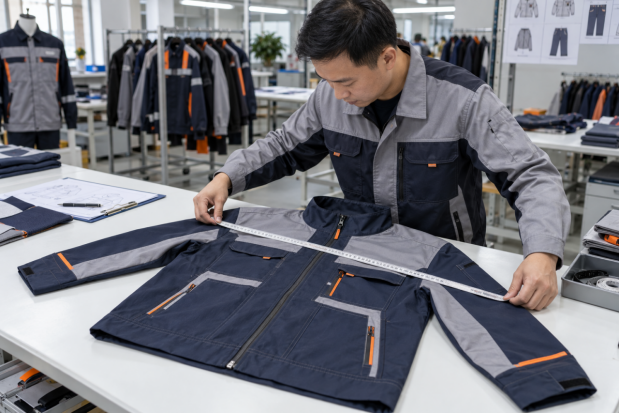
What to Check on a Workwear Sample
Inspect the garment measurements, proportions, seam quality, pocket positions, reinforcement, zipper operation, logo placement, fabric color, labels and packaging. The sample should also be worn or tested for basic movement when fit and mobility are important.
How to Record Sample Revisions
Record every requested change in one sample review document. Use photographs, marked drawings and a measurement table where possible. General comments such as “make it larger” or “improve the pocket” can be interpreted differently by each party. Once revisions are complete, confirm which sample and specification version will control bulk production.
7. Audit the Workwear Manufacturer’s Quality Control Process
A professional quality process should begin before sewing and continue through packing. Ask the supplier to explain who performs each inspection, what records are kept and how defects are corrected.
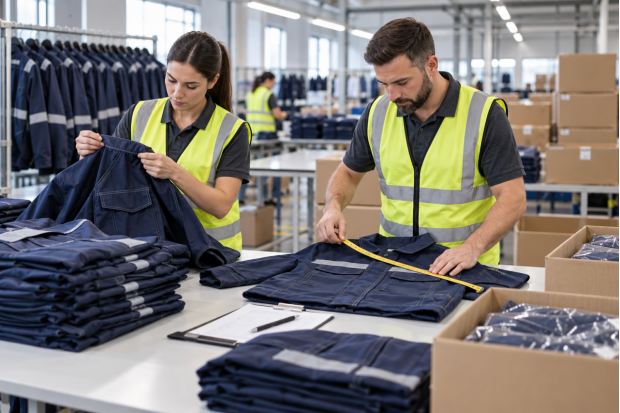
Fabric and Accessory Inspection
Incoming inspection should verify fabric type, color, quantity and visible defects. Zippers, buttons, reflective materials, labels and other accessories should match the approved specification before they enter production.
In-Line Workwear Inspection
In-line inspection helps identify sewing and construction problems before a complete batch is finished. Typical checks include seam quality, skipped stitches, pocket position, reinforcement, component matching and key measurements.
Final Inspection and Packing Checks
Final inspection should cover garment appearance, measurements, workmanship, logo and label accuracy, quantity, size ratio and packing. For larger orders, buyers may arrange a pre-shipment inspection using agreed tolerances and a defined sampling method.
8. Verify Custom Workwear Production Capacity and Lead Time
A competitive quotation has limited value if the factory cannot meet the required delivery date. Ask for a realistic schedule covering sample development, material sourcing, bulk production, inspection, packing and shipment preparation.
Sample and Material Preparation Time
Custom-dyed fabrics, specially developed accessories and revised samples can extend the schedule. Confirm when the lead time begins. In many cases, production starts only after the sample, color, size chart, order details and payment terms are approved.
Bulk Workwear Production Lead Time
Ask about current capacity and peak-season workload, not only the factory’s theoretical monthly output. A credible supplier should be able to provide progress updates and identify schedule risks early enough for the buyer to respond.
9. Assess the Workwear Supplier’s Communication and Documentation
Communication during quotation and sampling is often a useful indicator of how the supplier will manage the bulk order. A reliable custom workwear manufacturer should answer technical questions clearly, confirm specifications in writing, record revisions and report potential delays promptly.
Use a product specification, measurement chart, approved sample and order confirmation as the shared reference. Important details should not remain scattered across informal messages. When a requirement changes, update the controlled document and confirm that both sides are using the same version.
10. Compare the Total Cost of Custom Workwear Manufacturing
The lowest unit price does not always provide the lowest total cost. A quotation may exclude sample development, custom labels, individual packaging, special accessories or inspection. Quality failures can also create replacement costs, customer complaints and delivery delays.
Compare suppliers using the same specification and review product quality, material details, customization, MOQ, sample accuracy, quality control, lead time, packaging, communication and total landed cost. An itemized quotation makes price differences easier to understand and allows the design to be adjusted without removing essential requirements.
Custom Workwear Manufacturer Evaluation Checklist
- The custom workwear manufacturer has relevant industrial workwear experience.
- Fabric composition, weight, color and performance requirements are documented.
- Measurements and tolerances are agreed upon.
- Customization, logo, labels and packaging are confirmed.
- MOQ is clear for each style and color.
- The pre-production sample has been approved.
- Quality control requirements are written into the order.
- Production and delivery dates are realistic.
- Required test reports or certification documents have been verified for the exact product.
Why Work with Toprise as Your Custom OEM Workwear Manufacturer
Toprise provides custom OEM and private-label workwear solutions for importers, distributors and brands. Available product categories include work jackets, work trousers, coveralls and coordinated workwear sets.
Customers can customize garment colors, functional details, logos, labels, sizing and packaging according to their project requirements. To discuss a custom workwear project, send us your design, reference sample, specification sheet, target quantity and required delivery date. Our team can review the information and recommend a suitable development and production approach.
Frequently Asked Questions About a Custom Workwear Manufacturer
How Do I Choose a Custom Workwear Manufacturer?
Compare the custom workwear manufacturer’s relevant product experience, fabric knowledge, sampling process, customization options, MOQ, quality control, capacity, lead time and communication. Approve a complete sample and written specification before bulk production.
What Is the Typical MOQ for Custom Workwear?
The MOQ depends on fabric availability, color, style complexity, accessories, logo method, labels and packaging. Ask whether the minimum applies to the total order, each style or each color.
How Long Does Custom Workwear Production Take?
Lead time varies according to sample revisions, fabric sourcing, order quantity, factory schedule and packaging requirements. Request a schedule that separates sample development, material preparation, bulk production, inspection and shipment preparation.
Can a Workwear Manufacturer Add Our Logo and Labels?
Most custom workwear manufacturers can provide embroidery, printing, heat transfer, private labels, hangtags and custom packaging. Approve the selected branding method on the actual garment fabric before production.
What Information Should I Send to an OEM Workwear Manufacturer?
Send the garment type, reference images or technical drawing, fabric preference, colors, size range, functional details, logo files, labels, packaging, order quantity, destination and target delivery date.


 French
  English
  Russian
  Arabic
  Portuguese
  Japanese
  German
  Spanish
  Afrikaans
  Greek
Greek  Italian
  Thai
Thai