
Static electricity is often invisible, but its effects can be serious. In electronics manufacturing, precision assembly, chemical processing, and other controlled environments, electrostatic discharge may damage sensitive components, attract dust, interrupt production, or increase workplace risks.
ANTI-STATIC WORKWEAR is designed to reduce the generation and accumulation of electrostatic charges on clothing. However, selecting suitable garments involves more than choosing a product labeled “anti-static.” Buyers should also consider fabric composition, conductive yarn structure, fabric weight, garment design, washing method, and the actual working environment.
This guide explains what ANTI-STATIC WORKWEAR is, where it is used, how to select the right fabric and weight, how to wash it correctly, and whether its anti-static properties disappear after repeated cleaning.
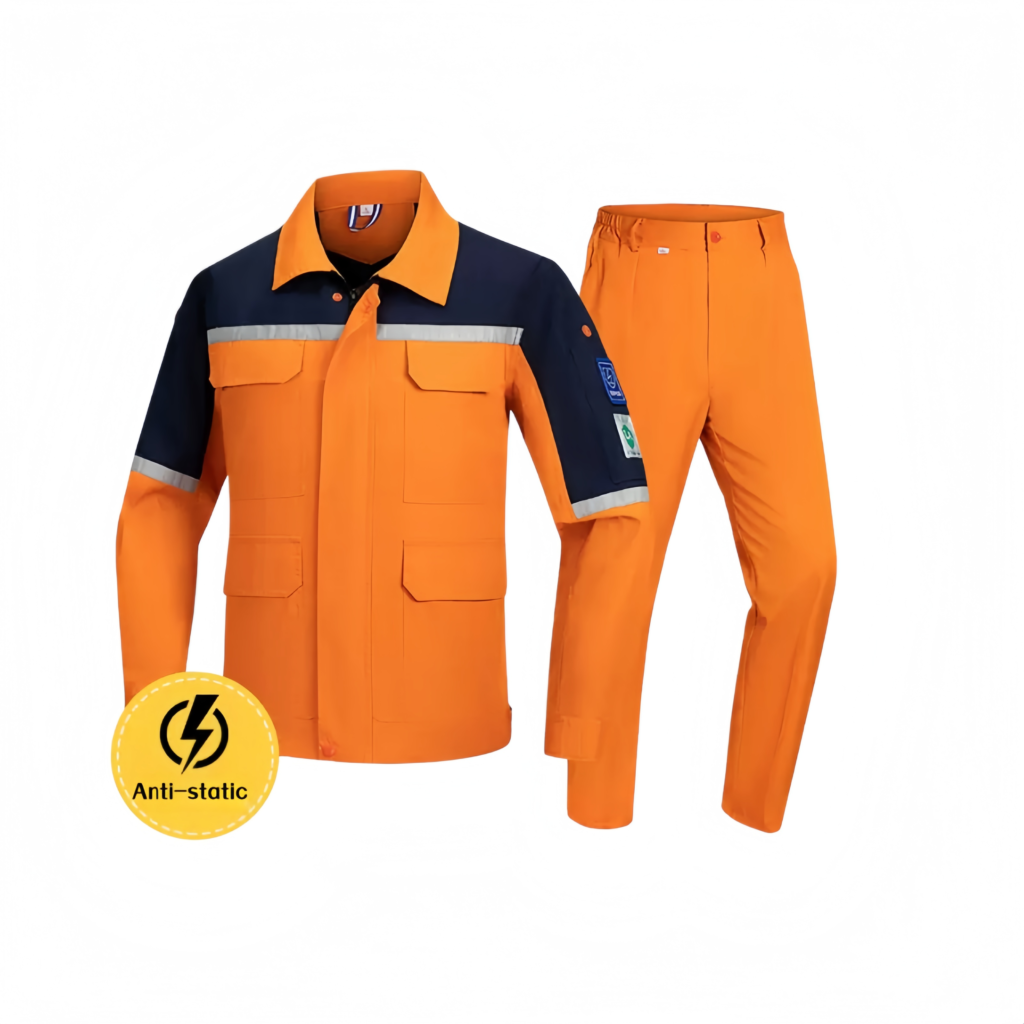
1. What Is ANTI-STATIC WORKWEAR?
ANTI-STATIC WORKWEAR is protective clothing made from fabrics designed to limit static electricity generation and help accumulated charges dissipate safely.
Most anti-static fabrics are produced by weaving conductive yarn into polyester, polyester-cotton, or cotton-based fabric. The conductive yarn creates a charge-dissipation path across the garment. Instead of remaining concentrated on the surface, electrostatic charges can spread and dissipate more effectively.
Conductive yarn may appear as fine stripes or grid patterns in the fabric. The spacing and arrangement of these yarns depend on the fabric construction and the intended electrostatic performance.
How Does Anti-Static Fabric Work?
Static electricity is commonly generated when two materials rub against each other. During normal movement, clothing can rub against underwear, equipment, seats, or other surfaces.
Anti-static fabric helps reduce the amount of charge that remains on the garment. Conductive fibers provide a path through which the charge can move instead of accumulating in one area.
This does not mean that the garment produces no static electricity at all. The purpose of ANTI-STATIC WORKWEAR is to reduce static accumulation and support controlled charge dissipation.
Conductive-Yarn Fabric vs. Anti-Static Finish
Conductive-Yarn Fabric
Conductive yarn is permanently woven into the fabric structure. This construction generally provides more stable anti-static performance during normal use and repeated washing.
Surface-Treated Fabric
Some fabrics use an anti-static chemical finish applied to the surface. These materials may provide useful initial performance, but the treatment can gradually weaken after repeated washing, abrasion, and long-term use.
For industrial uniforms that require regular laundering, conductive-yarn fabric is often the more durable option.
2. Where Is ANTI-STATIC WORKWEAR Used?
The application of ANTI-STATIC WORKWEAR depends on workplace hazards, product sensitivity, contamination-control requirements, and environmental conditions.
Electronics and Semiconductor Manufacturing
Electronic components such as circuit boards, chips, sensors, and integrated devices can be sensitive to electrostatic discharge.
Workers involved in assembly, inspection, testing, packaging, maintenance, and storage may need anti-static garments to reduce the risk of static-related damage.
Precision Instruments and Optical Equipment
Static electricity can attract dust and small particles. In precision assembly environments, contamination may affect product quality, optical performance, or measurement accuracy.
Anti-static garments help reduce dust attraction and support a cleaner production environment.
Automotive and Mechanical Manufacturing
Automotive production, machinery assembly, metal processing, and equipment maintenance require workwear that can withstand frequent movement, repeated washing, and contact with tools or machinery.
Polyester-cotton anti-static twill is commonly used because it combines abrasion resistance, shape retention, moderate comfort, easy maintenance, and static-dissipative performance.
Chemical, Petroleum, and Gas Industries
In workplaces containing flammable gases, vapors, liquids, or combustible dust, electrostatic discharge may become an ignition risk.
Garments used in these environments must be selected according to the actual workplace risk assessment and applicable safety requirements. A garment should not be considered suitable for a hazardous area only because it is marketed as ANTI-STATIC WORKWEAR.
The complete protective system may also include suitable footwear, flooring, grounding measures, and operating procedures.
Pharmaceutical and Clean Production Areas
Anti-static garments are also used in pharmaceutical production, laboratories, cleanrooms, medical-device manufacturing, and controlled packaging areas.
These workplaces may require additional fabric properties such as low linting, low particle release, cleanroom compatibility, dust resistance, and easy decontamination.
Warehousing and Logistics
Packaging materials, synthetic products, conveyors, and industrial handling processes can generate static electricity.
Warehousing and logistics companies may use anti-static uniforms when static control is necessary for product protection, workplace management, or operational safety.
3. How to Choose the Right Fabric for ANTI-STATIC WORKWEAR
The correct fabric depends on the working temperature, physical workload, washing frequency, required durability, and level of electrostatic control.
Polyester Anti-Static Fabric
Polyester anti-static fabric is strong, dimensionally stable, quick-drying, and relatively easy to maintain.
It is commonly used for lightweight anti-static uniforms, cleanroom garments, laboratory coats, production-area jackets, and light-duty coveralls.
Polyester has limited moisture absorption, so it may feel less comfortable in hot environments or during heavy physical work.
Polyester-Cotton Anti-Static Fabric
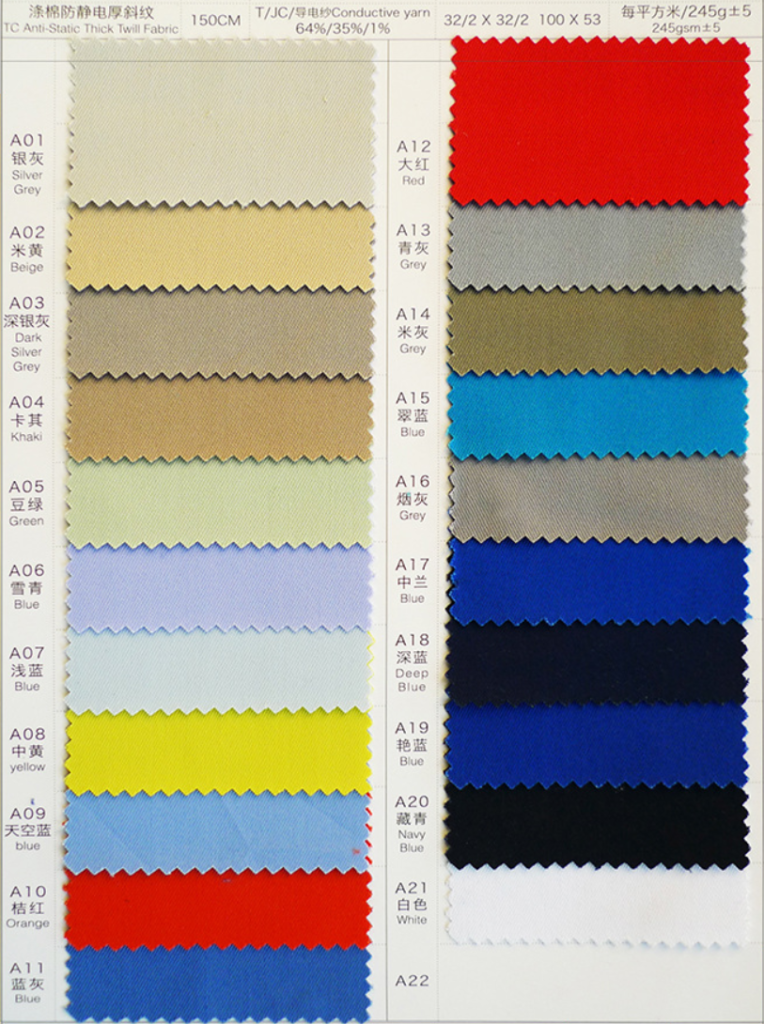
Polyester-cotton fabric combines the durability of polyester with the comfort of cotton.
Polyester improves abrasion resistance, crease resistance, shape retention, and drying speed. Cotton improves moisture absorption, softness, wearing comfort, and skin feel.
Conductive yarn provides the anti-static function. This makes polyester-cotton fabric a practical option for general industrial ANTI-STATIC WORKWEAR.
Anti-Static Twill Fabric
Twill fabric has visible diagonal lines and a dense woven structure. Compared with similar plain-weave fabrics, twill often provides better flexibility, abrasion resistance, and garment structure.
Anti-static twill is suitable for work jackets, work trousers, industrial uniforms, coveralls, and maintenance clothing.
Heavy Anti-Static Twill Fabric
Heavy twill is thicker and more durable than lightweight anti-static fabric. It provides better structure and resistance to daily wear.
A polyester-cotton anti-static twill fabric weighing approximately 245 g/m² is suitable for spring and autumn workwear. It can be used for industrial jackets, trousers, and coveralls in machinery, automotive, warehouse, and general manufacturing environments.
Anti-Static Drill and Canvas
Anti-static drill and canvas are designed for demanding work. They offer high abrasion resistance, greater thickness, strong garment structure, and better resistance to rough handling.
However, they may feel warmer and less breathable. They are generally more suitable for heavy-duty work than for hot production areas.
4. How to Select the Right Fabric Weight
Fabric weight is usually measured in grams per square meter, written as g/m². It affects thickness, breathability, durability, drape, and seasonal suitability.
| Fabric weight | General characteristics | Typical applications |
| 90–150 g/m² | Lightweight and breathable | Summer uniforms, shirts, selected cleanroom garments |
| 150–210 g/m² | Balanced comfort and durability | General workwear, spring and summer uniforms |
| 210–280 g/m² | Medium-heavy and abrasion-resistant | Industrial jackets, trousers, and coveralls |
| 280–450 g/m² | Heavy and highly durable | Heavy-duty workwear, drill, and canvas garments |
Lightweight Fabric: 90–150 g/m²
Lightweight fabric is suitable for warm environments and jobs with limited abrasion. It provides better breathability and reduces heat burden, but it may not offer enough durability for heavy mechanical work.
Medium-Weight Fabric: 150–210 g/m²
Medium-weight fabric provides a practical balance between comfort, strength, and appearance. It is suitable for general factory uniforms, spring and summer workwear, and workplaces where workers need to move frequently.
Medium-Heavy Fabric: 210–280 g/m²
Medium-heavy fabric is commonly used for industrial ANTI-STATIC WORKWEAR. It provides better abrasion resistance, greater fabric strength, a more structured appearance, and better suitability for jackets and trousers.
A weight of around 245 g/m² is a practical choice for spring and autumn workwear.
Heavy Fabric: 280–450 g/m²
Heavy fabrics are suitable for jobs involving frequent contact with rough surfaces, tools, or machinery. They provide better durability but may reduce breathability and increase heat stress.
Is Higher Fabric Weight Always Better?
No. Higher fabric weight does not automatically mean better anti-static performance.
Anti-static performance mainly depends on the conductive structure, fabric design, garment construction, and compliance with the required test criteria. Fabric weight primarily affects physical durability, thickness, comfort, and seasonal suitability.
5. How Should ANTI-STATIC WORKWEAR Be Washed?
Correct washing helps protect the conductive yarn, fabric structure, color, and overall garment performance. Always follow the garment care label and the manufacturer’s laundering instructions.
Before Washing
- Empty all pockets and remove sharp objects or metal tools.
- Close fasteners when recommended.
- Check the garment for tears, damaged seams, and broken conductive yarn.
- Separate heavily contaminated garments.
Use Mild Detergent
Use a mild or neutral detergent. Avoid strong acids, strong alkalis, chlorine bleach, and aggressive oxidizing agents because they may damage the main fibers, conductive yarn, or anti-static finish.
Control the Water Temperature
For many polyester-cotton garments, a washing temperature of approximately 30–40°C may be suitable. However, the care label should always take priority because washing requirements vary according to the fabric, dye, garment accessories, and conductive material.
Avoid Excessive Mechanical Action
Do not use hard brushes or aggressive scrubbing. Long soaking, intensive washing cycles, and excessive spin speeds may accelerate fabric wear and damage conductive yarn.
Avoid Mixing with Lint-Producing Garments
Wash anti-static garments separately or together with similar workwear. Do not mix them with towels, fleece, heavily linting fabrics, or garments contaminated with large amounts of oil, resin, or chemicals.
Use Fabric Softener Carefully
Some fabric softeners leave a coating on the fiber surface. This coating may interfere with charge dissipation or create contamination problems in controlled environments. For cleanroom or static-sensitive applications, follow the workplace laundering procedure and avoid unauthorized softeners.
Dry at a Suitable Temperature
Air drying is often suitable. Low-temperature tumble drying may also be used when permitted. Avoid excessive heat, prolonged high-temperature drying, long exposure to strong sunlight, and high-temperature ironing.
Recommended Washing Methods
Machine Washing
Use a gentle or moderate washing cycle when permitted by the manufacturer.
Hand Washing
Do not twist, rub, or brush the fabric aggressively. Handle the garment carefully, particularly around seams, cuffs, elbows, and knees.
6. Does Washing Remove the Anti-Static Function?
Normal washing does not usually cause the anti-static function to disappear immediately. The long-term result depends mainly on how the fabric obtains its anti-static properties.
Conductive-Yarn ANTI-STATIC WORKWEAR
When conductive yarn is woven into the fabric, it becomes part of the textile structure. Proper washing does not remove the yarn. Therefore, this type of ANTI-STATIC WORKWEAR usually retains its function better than fabric that depends entirely on a temporary surface treatment.
Performance may still decline when:
- Conductive yarn breaks.
- The fabric becomes severely worn.
- Harsh chemicals damage the fibers.
- High temperatures affect the garment.
- Oil or resin covers the fabric surface.
- Seams and closures become damaged.
Surface-Treated Anti-Static Fabric
Surface-treated fabric relies on an anti-static chemical finish. Repeated washing can gradually remove the finish. As a result, the anti-static effect may weaken over time.
Buyers should check:
- The declared wash durability.
- The recommended washing method.
- The maximum washing temperature.
- Performance after repeated laundering.
- Relevant test reports.
Can a Garment Look Fine but Lose Performance?
Yes. A garment may look clean and undamaged while its conductive performance has declined. Oil, paint, resin, dust, and chemical residues may form a layer on the fabric and interfere with charge dissipation.
In higher-risk workplaces, appearance alone should not be used to determine whether a garment is still suitable.
7. When Should Anti-Static Garments Be Replaced?
A company should establish inspection and replacement procedures according to workplace requirements.
The garment should be inspected or replaced when it has:
- Severe abrasion.
- Tears or holes.
- Broken conductive yarn.
- Damaged seams.
- Permanent oil contamination.
- Chemical damage.
- Burn marks.
- Excessive shrinkage.
- Loss of required anti-static performance.
For higher-risk environments, periodic performance testing may be necessary after a specified number of washing cycles.
Conclusion: Choose ANTI-STATIC WORKWEAR as Part of a Complete Safety System
ANTI-STATIC WORKWEAR is designed to reduce electrostatic charge accumulation and support controlled charge dissipation. It is widely used in electronics manufacturing, precision assembly, automotive production, machinery, pharmaceutical facilities, cleanrooms, chemical processing, and logistics.
The correct garment should be selected according to workplace risk, temperature, workload, washing frequency, and required durability. Lightweight fabrics are suitable for warm environments, while polyester-cotton anti-static twill in the 210–280 g/m² range is a practical choice for general industrial uniforms. Heavy drill and canvas are more suitable for demanding work where abrasion resistance is a priority.
Washing does not normally eliminate the anti-static function of fabric containing woven conductive yarn. However, repeated abrasion, excessive heat, harsh chemicals, contamination, and broken conductive fibers can reduce performance.
For reliable protection, ANTI-STATIC WORKWEAR should be correctly selected, professionally maintained, regularly inspected, and used together with suitable footwear, flooring, grounding systems, and workplace procedures.


 English
  Russian
  Arabic
  Portuguese
  Japanese
  German
  Spanish
  Afrikaans
  Greek
Greek  Italian
  Thai
Thai  French